Cracker
Ledger effect: diverted
Pre-combustion carbon valorization from pipeline gas. Fossil carbon leaves the molecule as solid material rather than as combustion CO2.
The HydroCarbon Forge splits hydrocarbons before combustion. Carbon exits as structural material; hydrogen flows to the Synterran Cycle to power compute. Two revenue streams from one molecule of fuel — and the thermodynamic route to a net-negative hydrocarbon economy at full scope.
The Forge is a long-horizon architectural track. Initial Synterran deployments operate without it. Where CO2 is captured, it is sequestered pending Forge development. This page describes the architecture and its implications; it does not describe a shipping product.
Combustion converts a hydrocarbon molecule into CO2, water, and heat. The Forge intercepts the molecule before that happens. In methane cracking, CH4 → C(s) + 2H2 — solid carbon and hydrogen.
Hydrogen carries roughly 56% of the combustion energy. The remaining 44% stays in the solid carbon as chemical exergy — the potential that combustion would otherwise destroy by dropping carbon to the CO2 thermodynamic dead state. Extracted as durable material, that exergy is preserved. Hydrogen goes to the cycle; carbon goes to construction.
The Forge sits between three external worlds — the Utility, Biosphere, and Technosphere — and the Synterran Cycle. Fuel Synthesis & Conditioning (FSC) is the single interface to the Cycle: pipeline gas enters, cracking fraction is decided, and the resulting fuel blend is delivered.
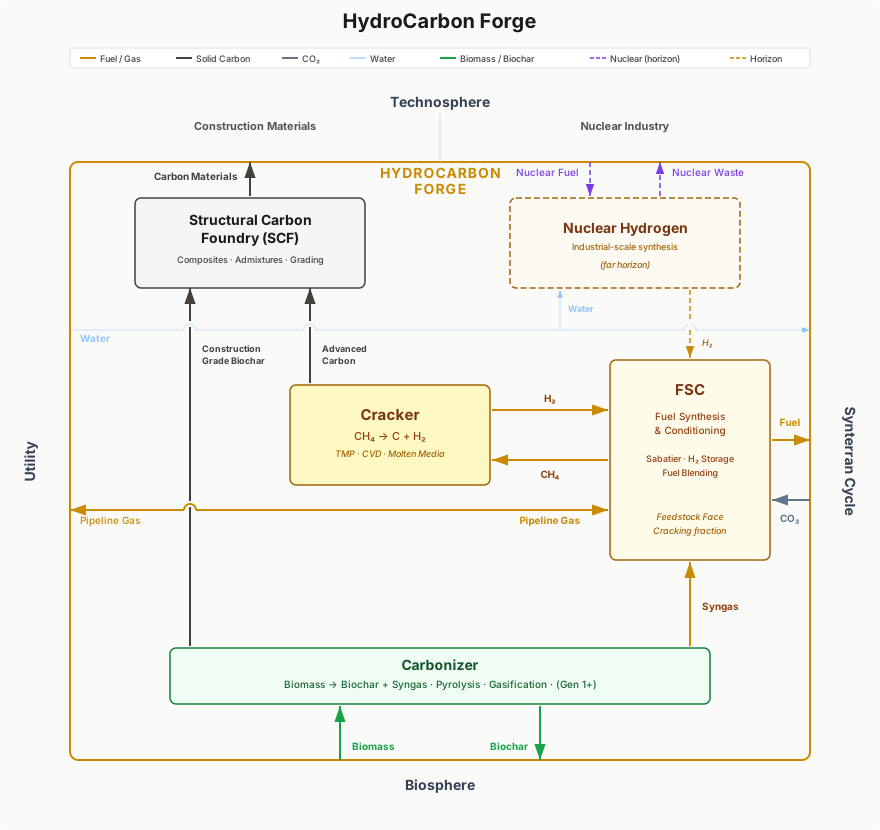
The Forge's carbon effect is not a single mechanism. It is three capabilities that compose additively — each one makes the carbon ledger more favorable without architectural redesign.
Ledger effect: diverted
Pre-combustion carbon valorization from pipeline gas. Fossil carbon leaves the molecule as solid material rather than as combustion CO2.
Ledger effect: removed
Atmospheric carbon input via biomass. Inverts the ledger from diverted to removed — biomass-derived carbon entered the atmosphere recently, and the Forge routes it to permanent material.
Ledger effect: recyclable
Industrial-scale hydrogen synthesis paired with CO2 recycling via Sabatier methanation. CO2 becomes feedstock; carbon capacity scales beyond pipeline gas and biomass.
Pipeline gas is the permanent substrate. The Carbonizer adds atmospheric carbon alongside it. Nuclear hydrogen is a far-horizon capability. The commercial-scale infrastructure it depends on doesn’t yet exist at relevant scale.
The Synterran Cycle’s value compounds with deployment. A single unit decarbonizes its own fuel while generating power. Deployed broadly through licensing, it becomes a systemic lever on industrial carbon. At the 250 GW target referenced on the main page, the architecture materially shifts the construction materials picture and combined sequestration reaches a scale commensurate with global annual emissions under conservative assumptions. Thresholds below that are milestones along the path.
What’s deterministic is the unit thermodynamics. Everything else depends on deployment rate, displacement economics, and policy.
Forge deployment is post-Deployment 1. Concrete deployment plans emerge after the Synterran Cycle is validated at pilot scale on the compute-co-located platform. Many components specified here exist to define boundaries and interfaces — not for near-term construction. The architecture is documented at full scope so that today’s build fits tomorrow’s scale.
Research collaborators, strategic partners, and investors interested in the Forge development track: reach out through the Synterran contact surface.